
As a creative writer, one of the biggest challenges I face is figuring out the best way to tell my story. I’m sure many of you can relate. Do I start with a prologue or jump right into the action? Should I use a linear timeline or flashbacks? How many perspectives should I include? These are just some of the questions that I contemplate.
Because I often have numerous ideas floating around in my head, I’ve found it helpful to plot out my story three ways. I’ve found that it helps develop the story, plus make it better and gives more material to pull from as you refer back to it when you get stuck writing.
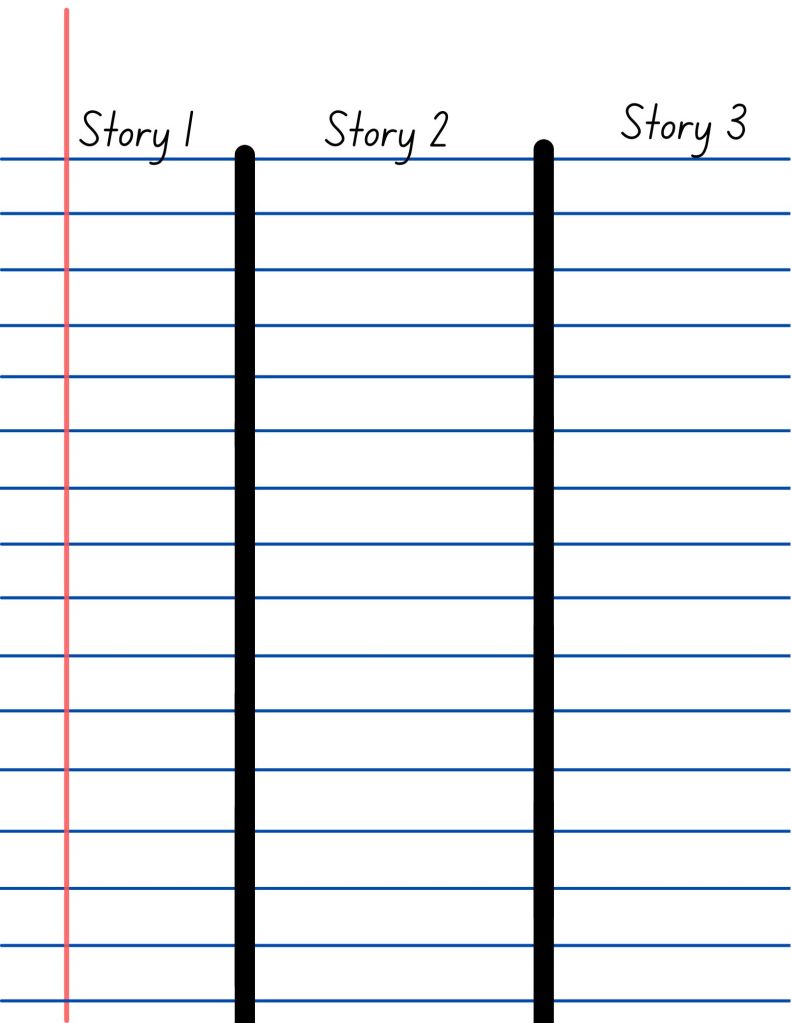
After bullet pointing the general story on one sheet of notebook paper, I take a couple of pieces of notebook paper and draw 2 lines to make 3 columns. I then writhe the story three different ways.
Step 1: The Linear Plot
The first thing I do is write out a linear plot of my story. This means starting at the beginning and moving through the story in a chronological order. I try to include all the major plot points and character arcs in this version.
This helps me get a sense of the overall structure of the story and identify any pacing issues. It also helps me see if there are any gaps in the plot or if certain events feel rushed or dragged out.
Step 2: The Nonlinear Plot
Next, I write out a nonlinear version of the plot. This means jumping around in time, using flashbacks, or other techniques to create a more complex narrative structure. This version allows me to experiment with different ways of revealing information to the reader.
Sometimes, I find that the nonlinear version is more interesting and engaging than the linear version. Other times, I realize that it’s too confusing or doesn’t add anything to the story. Either way, this version helps me think outside the box and consider different ways of telling the story.
Step 3: The Character Plot
Finally, I write out a version of the plot that focuses on the character arcs. This means looking at the story from each character’s perspective and seeing how their personal journeys intersect with the larger plot.
This version helps me make sure that each character is fully developed and has a clear motivation. It also helps me see if any characters are unnecessary or underdeveloped. I then can go back and adjust my chapters to fit the way I will tell the story.
By plotting out my story three ways, I’m able to see the strengths and weaknesses of each version and choose the one that works best for the story I want to tell. Sometimes, I even combine elements from each version to create a unique and compelling narrative.
If you’re a writer struggling with how to tell your story, I highly recommend trying this process. It may take a bit of extra time and effort, but it’s well worth it to find the best way to bring your story to life.
Thanks for reading, and happy writing!
Em
Morgan Harper Nichols had a timely post on this topic just this week! Love her art and words!
 Create Everyday