
This is a sample passage from the memoir I’m writing called “When Tomorrow Starts Without Me,” a non-fiction book that has a theme of waking up to various forms of loss throughout my life and how I persevered with my faith in tact.

If the theme of September 11 was the loss of American innocence…

The theme of the 12th is resilience.


In the years leading up to September 11, 2001, America felt like a place where safety was almost taken for granted. It was as if we believed we had an invisible shield protecting us from bad things happening here. We thought that war zones were far away, not on our backyards. It was a time when we could live our lives without constantly worrying about our safety, and that secure feeling was part of what defined my childhood.
What happens when you wake up one day under the blue skies of a seemingly safe world, but then it unfolds into another reality? What happens when you wake up tomorrow with innocence lost in yesterday’s wake?
Living in America at the turn of the century was a hopeful time. I was in college, and my generation was excited about all of the emerging technology and the career opportunities that were promised. But one crisp September morning, our attention was taken away from ourselves and onto the smoke filled city skies on our TV screens.
I was focused in my graphic art class, rolling the mouse around the screen while the printers hummed on the third floor of that old Mississippi building. The room, reserved for the art department, was where we worked on projects with our discmans playing Sarah McLachlan and Counting Crows on our headphones.
As I focused on my design project, a familiar voice began to creep through the walls—the voice of Peter Jennings, whom I usually heard on the evening news. But this time, his live broadcast on the radio at the 8:00 a.m. hour grabbed my attention, making me wonder what he was reporting.
“There is chaos in New York at the moment,” he reported, his voice serious, making me listen more closely. “I don’t want to call it an attack just yet.”
His words weighed heavy on my heart. I logged out of my computer and walked down the hall, deciding to get some fresh air and coffee at the student union. I thought maybe there I could get a visual on the TV.
I entered the union and joined other students gathered around the screen. The voices of everyone filled the room as we all questioned what we were seeing, unable to believe it. We were all thinking it must have been an accident.
Little did we know, we were witnessing history. The news continued to unfold, and as the world watched in horror, the reality of the situation began to sink in. The iconic twin towers, a centerpiece of the New York skyline and backdrop of numerous movie scenes, had fallen. We remarked that it looked like something out of a Hollywood blockbuster. How could this be real?
The shockwaves of the attacks rippled far beyond New York. Reports of the Pentagon being hit and a plane crashing in Pennsylvania heightened our fear that we were under attack. It gave me an eerie feeling wondering who or what might be hit next.
In the days and weeks that followed, the world was changing before our eyes. Air travel, once exciting, became anxiety-inducing with long wait times due to heightened security measures. Fear of the unknown filled our minds, and the innocence we had taken for granted was gone.
But amidst the uncertainty, resilience emerged. Acts of kindness, faith, and service in the days that followed filled our nation with hope. We were unified, one nation under God. Churches were full and people were looking to faith in God to offer hope in the darkness.
For me personally, it felt as strong of a sorrow as a death in my family and just having been through my own personal tragedy, the sudden loss of my best friend, I knew to turn to the Lord in prayer and faith that He would work it all out for our good. It just took my cooperation to get up and face the next day.
Looking back on that September morning, I am reminded that life can change in an instant. There is no trouble free tomorrow promised. The world may have changed, but we found the courage to get up and face the future with the lessons we learned that day.
How Artists Responded to 9/11
Artists are the heart of America. We have the superpower of feeling what others are feeling in a more intense way. If you’re not careful though, those feelings of melancholy, can turn into depression if not channeled into artistic expression. We were meant to share our gifts as balm for our communities and our own souls.
Here’s where a few various artists put their 9/11 feelings.
Alan Jackson wrote a song.
Bruce Springsteen wrote an album.

A building was designed and built.

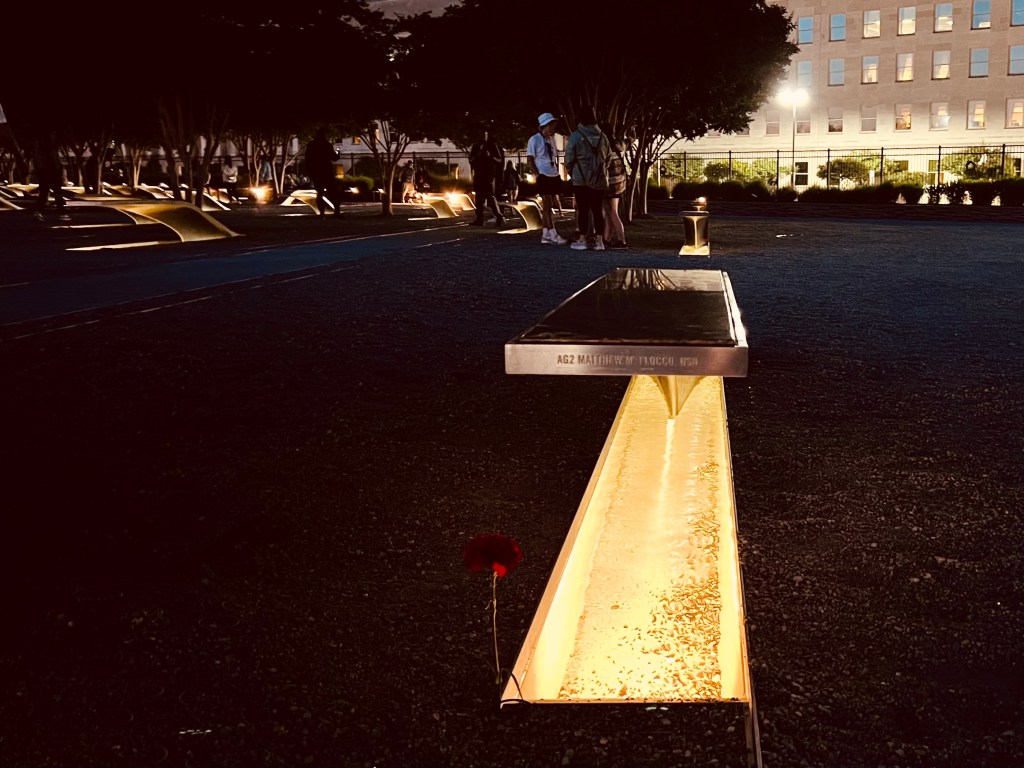
Memorials were installed.
Journaling Questions:
I encourage you to keep a record of this day and your experiences on 9/11 for future generations to read.
How does your faith guide your response when you witness suffering or injustice in the world?
In moments of tragedy or crisis, do you find help in prayer, and if so, how does it impact your outlook and actions?
Reflect on a time when your faith was challenged with a world event or personal circumstance that made you question your beliefs. How did you find resolution or clarity?
You have been reading a sample passage from the memoir I’m writing called “When Tomorrow Starts Without Me,” a non-fiction book that has a theme of waking up to loss in it’s various forms throughout my life and how I persevered with my faith in tact. This chapter will go on to highlight the various ways Americans have continued through many trials since 9/11.

 Create Everyday